
Tewkesbury Mustard Balls - Hot Stuff!
I was half-watching afternoon TV the other day when something caught my interest. The programme was about a couple who were looking for property in Gloucestershire. One of the houses they were shown was near Tewkesbury. Now, I have never been to Gloucestershire, and until that moment had never heard of Tewkesbury, but I was fascinated to learn, by chance, in that programme, about MUSTARD BALLS! This article is the result of the research that followed....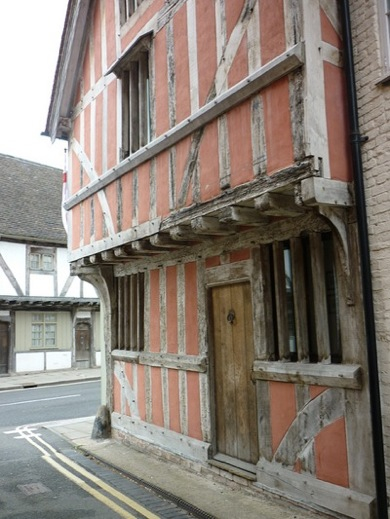
TEWKESBURY MUSTARD BALLS Tewkesbury,the 7th century Saxon town in Gloucestershire, was famous even then for its “mustard balls," a blend of mustard flour and grated Horseradish root. It was very popular in the early days, as it was easily stored, and when combined with vinegar or wine it could be made into a mustard paste as and when needed. Renowned for their excellence since mediaeval times, Tewkesbury mustard balls were sent all over the country.

From the Middle Ages the women of Tewkesbury gathered the ingredients from the fields and river banks about the town. A cannonball in an iron mortar was used to crush the mustard grain to a fine flour, then it was sieved to produce a fineness and purity that made Tewkesbury mustard so much sought-after throughout England. It was said that almost every house in Tewkesbury had its own cannon-ball for grinding mustard-seeds.
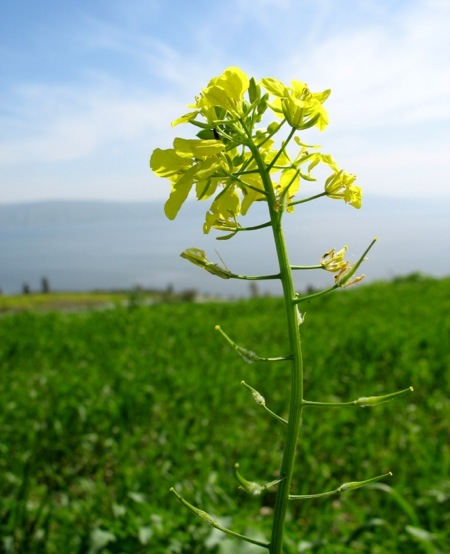
Horseradish was a common weed around Tewkesbury and was used to make the condiment hotter, but it caused great suffering during the preparation of the root because, before being soaked in cider or cider vinegar, the fumes are a painful irritant to the eyes.
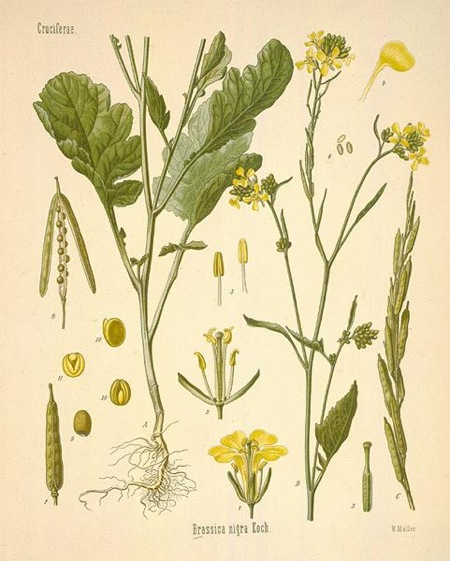
The mustard plant has yellow flowers which produce green pods containing the round mustard-seeds. These are patiently ground and mixed with vinegar or cider to make the mustard paste. In Tewkesbury, balls of mustard paste were the local speciality. Legend has it that Tewkesbury Mustard Balls covered in gold leaf were presented to Henry VIII when he visited Tewkesbury in 1535. This was a condiment fit for a king!
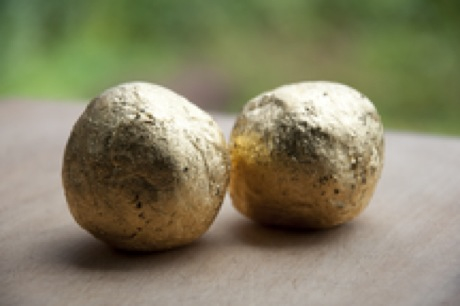
Grinding mustard seeds with a cannonball on a mustard quern was a technique described by a number of early modern period cookery authors such as Robert May, "Have good seed, pick it, and wash it in cold water, drain it, and rub it dry in a cloth very clean; then beat it in a mortar with strong wine-vinegar; and being fine beaten, strain it and keep it close covered. Or grind it in a mustard quern, or a bowl with a cannon bullet". [The Accomplisht Cook, London: 1660]
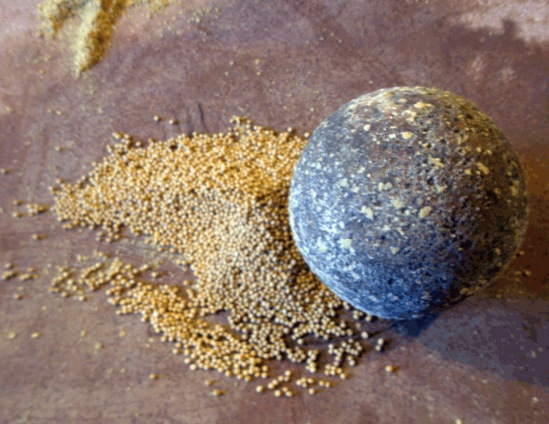
Although the precise recipe has been lost, the ingredients were simply local grown mustard seed, mixed with an infusion of horseradish, formed into balls and then allowed to dry on a board. The customer would then cut off as much as was required and steep it in water, milk, cider or cider vinegar until it was workable. The resultant mustard was “thick and pungent”. MUSTARD AFFECTING PERSONALITY AND BEHAVIOUR? Tewkesbury Mustard balls were believed to affect the nature of those who ate them, making them sharp-tempered and choleric: " He looks as if he had lived on Tewkesbury mustard, "was an old English proverb. "Tewksbury is a fair Market-town in this County, noted for the mustard-balls made there, and sent into other parts. This is spoken partly of such, who always have a sad, severe, and tetrick countenance. ... Partly of such as are snappish, captious, and prone to take exceptions." [Ray, 1737] "...the Mustard Balls made here, so proper for clearing the Head.... 'Tis very biting, and therefore has occasion'd this Proverb for a sharp Fellow..." [Magna, 1720] HENRY IV PART TWO An advertisement from Falstaff!
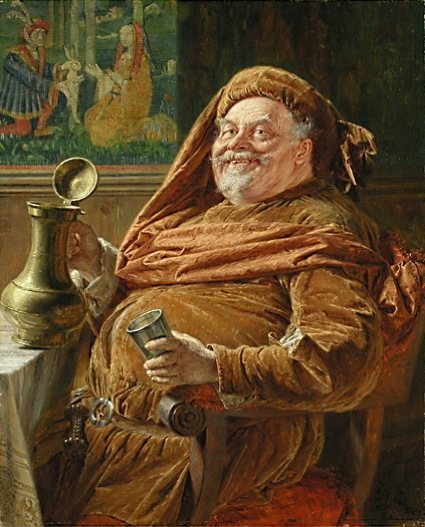
This was the form of mustard familiar to William Shakespeare when, in Henry IV, he gave a speech to Falstaff, describing Poins as having “a wit as thick as Tewkesbury mustard”. By 1662 Tewkesbury mustard was considered by Thomas Fuller, in The History of the Worthies of England, (London, 1662), the best in England. In 1712 Sir Robert Atkins, in his “New History of Gloucestershire”, finds Tewkesbury “remarkable for making balls of the best Mustard”. The manufacture of Tewkesbury mustard died out only at the beginning of the 19th century, perhaps coincidental with Mr Coleman of Norwich inventing his new process for producing mustard flour. The tradition is now restored as a cottage industry in the borough. Mustard balls are produced to order and on special occasions such as the re-enactment of the Battle of Tewkesbury in July of each year.
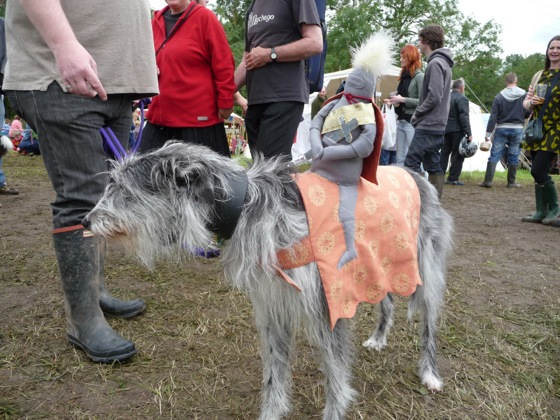
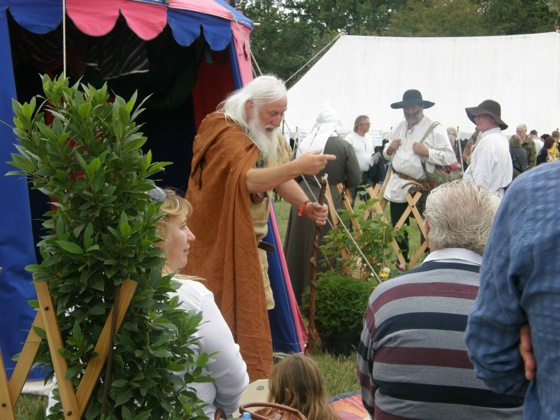
TEWKESBURY MEDIAEVAL FESTIVAL The Tewkesbury Mediaeval Festival is a mediaeval fair held over the second weekend of every July near the town of Tewkesbury, United Kingdom. Its main feature is the re-enactment of the Battle of Tewkesbury, which was fought in 1471. Located on parts of the ground where the original battle was fought, the festival also features a mediaeval camp, in which traders ply their wares and visitors are entertained by musicians and acrobats. The largest mediaeval fair in the United Kingdom, the Tewkesbury Medieval Festival was listed in Footprint England as one of the "ten most bizarre festivals" in the country.
The Festival started in 1984 as a simple fair with 10 stalls, a beer tent, and a small-scale re-enactment of the Battle of Tewkesbury, which was originally fought on 4th May, 1471 between the Houses of York and Lancaster. It became a regular celebration held over the second weekend of every July on parts of the original battlefield, with the main feature being its re-enactment of the famous battle. The actual engagement was a decisive victory for the Yorkists and their leader, King Edward IV. The forces of the House of Lancaster were decimated, and their leaders killed or captured, leaving Edward as the unchallenged ruler of England. Several Lancastrians fled the battlefield and sought sanctuary at Tewkesbury Abbey. The Yorkists stormed the abbey, captured their foes, and executed them.
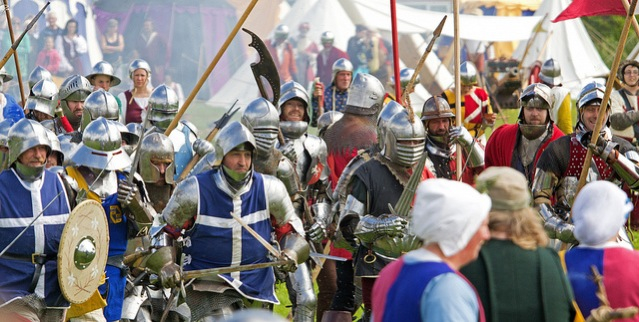
The re-enactment at the first festival was a simple affair compared to later years: approximately 100 local enthusiasts, kitted out in crude imitations of medieval gear, fought each other on the fields of Tewkesbury.They wore woollen chainmail or armour made of fibreglass. Their swords and pole arms were made from wood; arrows were rolled-up wallpaper.
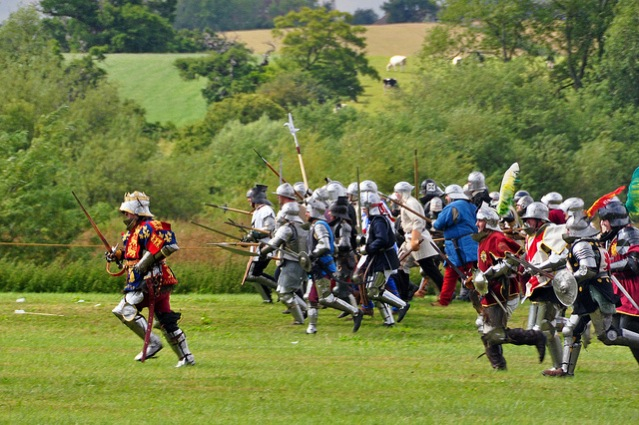
As the festival became more popular over the years, the scale and quality of the re-enactment changed. Re-enactors from other parts of the United Kingdom joined the event, as well as those from Poland, Germany and other European countries. The armour and weapons used in the later years were faithful steel reproductions that could cost thousands of pounds sterling. By 2002, the Battle of Tewkesbury was re-enacted by approximately 2,000 men and women, and the British Broadcasting Corporation called the next year's re-enactment the largest in Europe. Aside from the battle, the storming of Tewkesbury Abbey is also re-enacted during the festival. The subsequent trial and execution of the prisoners are acted out in a mock fashion. Since 2002, the festival has been more than a small setup of stalls. It has grown to be a camp of up to 120 stalls, where life in medieval times is enacted by participants of the battle and their families. The beer tent is a regular fixture, and the stalls offer herbs, sweetmeats and food. Entertainers, such as acrobats, fire-eaters, and jugglers, wander the area, performing their arts.
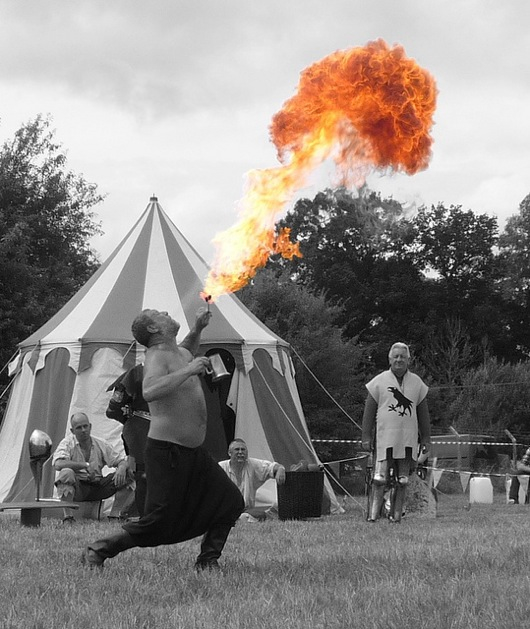
[Taken at Tewkesbury, July 10th, 2010] Musicians and dancers also entertain visitors. Re-enactors demonstrate pottery, yarn spinning, and other mediaeval craft.
Enthusiasts come from all over the world. The festival has attracted visitors from as far as New Zealand and the west coast of the United States; the local tabloid quoted an estimate of 25,000 visitors to the festival in 2003. SOME ANCIENT RECIPES FOR MUSTARD BALLS It is still possible to have Tewkesbury Mustard Balls made to order during the year, and to purchase them at the July Fair. Many recipes are still available. Below are some examples, from old cookery books. Mustard Balls were made from pounded mustard seeds, spices, and a binder such as wine, vinegar, honey or raisins. The balls were then dried in the sun or warm oven, and thus would "...keep better than mustard-seed or flour [ground mustard] at sea, and are easily dissolved." [Domestic Cookery,1827] To use, thin pieces were sliced and soaked in vinegar, wine or verjuice. An Italian medieval recipe by Platina, 1465 Combine pounded raisins with the mustard, cinnamon and cloves to form small balls, and dry on a board. A century later, a Dutch cookbook author, Vorselman, mixed the mustard powder with vinegar and a little flour, but no raisins. By the 18th century, the mustard was mixed with canary wine and honey. An 1827 recipe had the widest range of ingredients: spices, turmeric, fenugreek, cummin, or rice flour, and vinegar & sugar or wine & honey. [Domestic Cookery, 1827]
A 17th century traveller wrote: "Mustard off this place [Tewkesbury] is much spoken off, Made upp in balles as bigge as henns eggs, att 3d and 4d each, allthough a Farthing worth off the ordinary sort will give better content in my opinon, this beeing in sight and tast Much like the old dried thicke scurffe thatt sticks by the sides off a Mustard pott..." [The Travels of Peter Mundy in Europe and Asia, 1608-1667] Mustard balls may have been the size of cannon balls (about 3 inches). A quote from a gardening book in the 18th century stated "...make it up in large Balls about as big as Cannon or Mustard Balls." The calibres of cannon shot of that period were "3; 3.5; 4; 4.5; 5; 5.5; 6 inches ; which answer nearly to a 4, 6, 9, 13, 18, 24, and 31 pounders." [Muller, 1768] The calibre was fixed in 1726 for iron, but shot, such as grape shot or case-shot were smaller, ranging from 26 oz to 1 oz.
USE OF CANNON BALLS The grinding ball itself was also refered to as a Mustard Ball. The seeds could be ground on a "...mustard quern, or a bowl with a cannon-bullet..." [May, 1660] Cookbook authors suggested using a cannon ball or polished cannon ball to grind the mustard seed into powder. The cook could use "...a Bowl with a Cannon-Bullet...or in a Mortar with a Pestle." [Nott, 1723]
It could take "...an Hour in the Ceremony of grinding it in a wooden Bowl, and an Iron Cannon-Bullet, according to the old custom..." [Bradley, 1736] In a recipe to make curd pudding "...grind it with a mustard ball in a bowl, or beat it in a marble mortar..." [Moxon, 1790] At one time, in the whole of Gloucester county "...few farm-houses were without a cannon ball and bowl." [Rudge, 1807] SOME OLD RECIPES From The Cooks and Confectioners Dictionary,1723 TO MAKE MUSTARD BALLS Grind the Seed very fine, then make a Paste with Honey, and a little Canary; make it into Balls, and set them to dry in the Sun, or a gentle Oven, and keep them for use When you would use it, shave some of it very thin, put to it Vinegar and a little Salt. TO MAKE MUSTARD IN CAKES Take four Ounces of Seamy, an Ounce of Cinnamon, beat them with Vinegar and Hony very fine, in a Mortar, make it into a Paste, and then into little Cakes, dry them in an Oven, or in the Sun, when you would use them, dissolve them in Vinegar, Verjuice, or Wine.
From Domestic Economy, and Cookery, for Rich and Poor, by a Lady. London, 1827: MUSTARD BALLS Clean, wash and rub in a cloth the best mustard-seed, and steep it in vinegar, or wine and salt, for a night; pound it in a mortar, and rub it through a sieve ; add any spices well pounded with turmeric, fenugreek, cummin, or fine rice flour, and make it into balls with sugar and vinegar, or wine and honey, and dry them in the sun: when wanted for use, dissolve them in warm wine or vinegar; by this method, the ingredients are completely incorporated. These balls keep better than mustard-seed or flour at sea, and are easily dissolved. [Mustard balls were welcome additions to the sailor's dull diet: they stored well.] "To prepare mustard-seed for sea-store, kiln-dry it, to destroy the germ, steep it in spirits, and dry it again, pack it with pepper, from which it can be easily sifted; or pack raisins or a few currants along with it. So prepared, it will keep any length of time in pure sugar." Certainly it would have livened up the old ships biscuits!
I hope you found this interesting.....